| The
island of Jabuka (eng.: Apple) and Brusnik are the only two islands
among 1185 Croatian islands that are completely of volcanic origin. The island of Jabuka (43°05,5'N & 15°27,6E; island length: 180m, highness: 97m, coastline: 700m) lies some 28 nm west (276°) of Komiza on the island of Vis. Distance from the mainland is 32,7 nm (cape Ploca, near Rogoznica). The nearest island is the island of Svetac (aka Sveti Andrija, 12.2 nm) and the lighthouse of Barjak Mali (in front of Vis island, 25,2 nm). Due to magnetite that can be found in the black, volcanic rocks on the island, compasses become completely useless in the vicinity of this island. Boats can rarely be seen in these waters because the island lies far from all sea routes. Therefore, the island is visited only by those who have made it their destination. Jabuka can hardly be considered an island. The shoreline is not suitable for docking, the bays are not protected from winds, the steep cliffs make it impossible to build shelter, while the surrounding waters are deep (250m) and are not suitable for anchoring. The island of Jabuka is actually a very large, steep, 97 meter high cliff in the shape of a pyramid. It can only be accessed from the southwestern side during favorable weather conditions, which is rarely the case. Placed in deep waters, isolated from other islands and channels, Jabuka is exposed to strong winds. Even moderate winds cause large waves on the open sea, therefore one needs a lot of experience and luck to dock on the island. The surrounding waters are rich in fish. Due to the harsh climate, there are only two endemic species: black lizard and the plant Centaurea (Cro.: zecina). Till some 50 years ago, the island was home to an endemic type of carnation, nowadays extinct. |
The
island of Jabuka
(43°05,5N 15°27,6E) |
Ham Activity and Jabuka
The
island of Jabuka has always been a challenge for amateur radio operators,
attracting and drawing them as a magnet. |
||
|
When
there were no motorboats, only the bravest, most enduring fishermen
dared go to the island in order to provide for their families by catching
large fish and trapping valued lobsters. The island is both a remarkable
and frightening sight during nice weather in summer but in winter, when
the winds blow causing large waves, Jabuka turns into a life-threatening
adventure. There is definitely something remarkable and magnificent about these "frightening" volcanic islands containing magnetite that causes compass needles "go berserk" and influences those who come to the island of Jabuka, making them willing to torture their bodies, bear the harsh conditions and endanger their lives in order to test the limits of their spirits and presence of mind. Outdoor enthusiasts should visit Jabuka only in summer months with the help of an experienced crew.
"In
July/August 2005 Richard and Jacqui Peirce mounted an expedition led
by Richard and Craig Ferreira in the Central Adriatic to try to evaluate
predatory shark populations by conducting a three-week at sea round
the clock chumming operation...
SITE
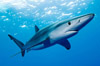
1. – 8 miles NW Jabuka 16 hours continual chumming. One confirmed
specimen Blue Shark (P. glauca) after 10 hours 15 minutes chumming.
2 metre female.
SITE 2. – 9 miles SW Jabuka. 19 hours continual chumming. Four confirmed specimens Blue shark (P. glauca). First specimen 3 metre female after 1 hour 20 minutes chumming, second specimen 2.5 metre male 45 minutes later..."
 |
 About
sharks in Jabuka area
About
sharks in Jabuka area